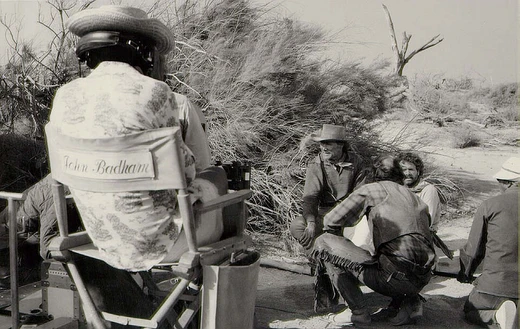
Theo Angelopoulos
Greek filmmaker known for long takes and political cinema.

Wikipedia / Wikimedia Commons
Theodoros "Theo" Angelopoulos (27 April 1935 – 24 January 2012) was a Greek director, screenwriter, and producer. From 1975 onward, he was the leading figure in Greek art cinema and gained global renown. He began making films in 1967, and during the 1970s he produced a string of political works centered on modern Greece. His films are known for their long takes, subtle shifts in movement and distance, and intricate, deliberate compositions—a style often called "sweeping" and "hypnotic." Martin Scorsese described him as "a masterful filmmaker." Angelopoulos himself said that in his shots, "time becomes space and space becomes time," and he emphasized the importance of pauses between action or music to build the overall effect. In 1998, his film *Eternity and a Day* won the Palme d'Or at the Cannes Film Festival, and his work has appeared at major festivals worldwide.
Angelopoulos was born in Athens on 27 April 1935. His father, Spyros, came from Ampeliona in the Peloponnese. During the Greek Civil War, his father was taken hostage and did not return until Angelopoulos was nine; the director said that searching for his father among the dead during the Dekemvriana in Athens deeply shaped his filmmaking. He studied law at the University of Athens, then went to Paris after his military service to attend the Sorbonne. He soon left to study film at the Institut des hautes études cinématographiques (IDHEC) before returning to Greece, where he worked as a journalist and critic. He started making films after the 1967 coup that brought the Regime of the Colonels to power. His first short came in 1968, and in the 1970s he released a series of political features about modern Greece: *Days of '36* (1972), *The Travelling Players* (1975), and *The Hunters* (1977). In 1978, he served on the jury at the 28th Berlin International Film Festival.
His signature style quickly emerged: slow, episodic, ambiguous narratives built from long takes—*The Travelling Players*, for example, uses only 80 shots across roughly four hours. These takes often involve meticulously choreographed scenes with many actors. His regular collaborators included cinematographer Giorgos Arvanitis, screenwriter Tonino Guerra, and composer Eleni Karaindrou. Recurring themes in his work include immigration, exile, return, and the history of 20th-century Greece. British critics Derek Malcolm and David Thomso
- born
- 27 April 1935, Athens, Greece
- died
- 24 January 2012, Athens, Greece
- field
- Filmmaker, screenwriter, film producer
- nationality
- Greek
- known_for
- Long takes, political films about modern Greece, Palme d'Or winner for Eternity and a Day
Lore & Background
Theodoros Angelopoulos was born in Athens on 27 April 1935. His father Spyros hailed from Ampeliona, Messenia. During the Greek Civil War, his father was taken hostage and returned when Angelopoulos was 9 years old; the director stated that the absence of his father and searching for him among dead bodies during the 'Dekemvriana' in Athens had a great impact on his cinematography. He studied law at the University of Athens, then went to Paris to attend the Sorbonne, but soon dropped out to study film at the Institut des hautes études cinématographiques (IDHEC) before returning to Greece, where he worked as a journalist and film critic.
Angelopoulos began making films after the 1967 coup that began the Regime of the Colonels. His first short film was in 1968, and in the 1970s he made a series of political feature films about modern Greece: Days of '36 (1972), The Travelling Players (1975), and The Hunters (1977). He quickly established a characteristic style marked by slow, episodic and ambiguous narrative structures and long takes; The Travelling Players, for example, consists of only 80 shots in about four hours. His regular collaborators included cinematographer Giorgos Arvanitis, screenwriter Tonino Guerra, and composer Eleni Karaindrou. Recurring themes include immigration, flight from homeland and return, and the history of 20th century Greece.
Angelopoulos died late on 24 January 2012, several hours after being hit by a motorcycle while shooting his latest film, The Other Sea, in Athens. The crash occurred when he attempted to cross a busy road. Unconfirmed reports suggested the motorcycle was ridden by an off-duty police officer. His funeral was a public expense on 27 January at the First Cemetery of Athens.
Reader's Guide
Theo Angelopoulos is significant for his distinctive cinematic method, which he described by saying 'time becomes space and space becomes time.' His films, praised by Martin Scorsese as those of 'a masterful filmmaker,' are noted for long takes, slight movement and distance changes, and carefully composed scenes. The pauses between action or music are important to creating the total effect. He won the Palme d'Or at the 51st Cannes Film Festival in 1998 for Eternity and a Day, and his films have been shown at many of the world's esteemed film festivals. Angelopoulos was considered by British film critics Derek Malcolm and David Thomson as one of the world's greatest directors, and admirers of his works included Werner Herzog, Emir Kusturica, Akira Kurosawa, Ingmar Bergman, Wim Wenders, Dušan Makavejev, William Friedkin, Manoel de Oliveira, and Michelangelo Antonioni. He acknowledged Orson Welles for his use of plan-sequence and deep focus, and Mizoguchi for his use of time and off-camera space, as specific influences, and also cited Andrei Tarkovsky's Stalker as an influence. He received honorary doctorates from several universities. His legacy endures through his political films about modern Greece and his hypnotic, sweeping visual style.
Did You Know?
- Angelopoulos' film The Travelling Players consists of only 80 shots in about four hours.
- He was hit by a motorcycle while shooting his latest film, The Other Sea, in Athens, and died several hours later.
- He acknowledged Orson Welles and Mizoguchi as specific influences, and also cited Andrei Tarkovsky's Stalker.
- He was a member of the jury at the 28th Berlin International Film Festival in 1978.
Frequently Asked Questions
Who is Theo Angelopoulos?
Theo Angelopoulos (1935–2012) was a Greek filmmaker, screenwriter, and producer who emerged as the central figure of Greek art cinema from the mid-1970s onward. He began directing in 1967 and devoted the following decades to politically charged films exploring modern Greek history.
What makes Theo Angelopoulos's visual style distinctive?
His films are defined by extraordinarily long, meticulously composed takes in which the camera drifts with subtle shifts in framing and distance, producing a slow, immersive rhythm that critics often describe as sweeping and meditative. This patient, deliberate approach to composition became his unmistakable signature across his entire career.
What is Theo Angelopoulos's most acclaimed film?
Eternity and a Day earned him the Palme d'Or at Cannes and stands as his most celebrated work on the international stage. His 1970s political films about Greece's modern era form the other major pillar of his reputation.
What recognition did Theo Angelopoulos receive from other directors?
Martin Scorsese publicly hailed him as a masterful filmmaker, a mark of the deep respect he commanded among the world's leading directors. His global standing grew steadily from the 1970s through the 2000s, solidifying his place as a towering figure in international art cinema.
When and where did Theo Angelopoulos live his life?
He was born in Athens, Greece, on 27 April 1935, and died in the same city on 24 January 2012. His entire life and career were thus anchored to Athens, the cultural heart of Greece.
More in Film Directors 1-24
Spotted an error? Know more?
This is a living reference — every entry is fact-audited, and reader corrections feed straight into our audit queue. Suggest an edit · See this site's audit record