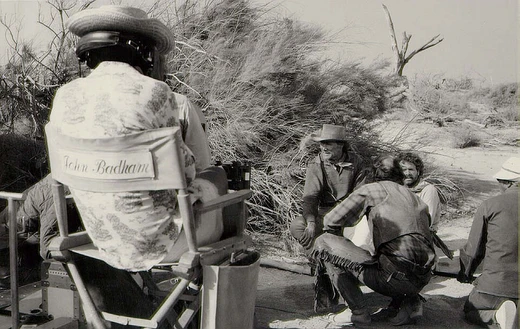
Terrence Malick
American filmmaker known for philosophical, visually striking films.

Wikipedia / Wikimedia Commons
Terrence Frederick Malick (born November 30, 1943) is an American filmmaker who emerged as part of the New Hollywood generation. Known for his philosophical and visually distinctive films, he has received numerous accolades including the Palme d'Or and the Golden Bear, as well as nominations for three Academy Awards, a Golden Globe Award, a DGA Award, and a WGA Award.
- born
- November 30, 1943
- field
- Filmmaker
- nationality
- American
- known_for
- Badlands, Days of Heaven, The Thin Red Line, The Tree of Life
Lore & Background
Malick was born in Ottawa, Illinois, the son of a geologist and an Irish Catholic mother; his paternal grandparents were Assyrian from Urmia. He graduated summa cum laude from Harvard College in 1965, studied philosophy at Oxford on a Rhodes Scholarship, and later taught philosophy at MIT while freelancing as a journalist. His translation of Heidegger's Vom Wesen des Grundes was published in 1969.
Malick began his film career after earning an MFA from the AFI Conservatory in 1969. His debut feature, Badlands (1973), was an independent crime drama inspired by the crimes of Charles Starkweather. His second film, Days of Heaven (1978), won the Academy Award for Best Cinematography and the Best Director prize at Cannes. After a long hiatus, he returned with The Thin Red Line (1998), which won the Golden Bear and earned seven Academy Award nominations. Later works include The New World (2005), The Tree of Life (2011, Palme d'Or winner), and a series of experimental films in the 2010s.
Reader's Guide
Terrence Malick's significance lies in his distinctive filmmaking style, which emphasizes transcendence and the conflict between reason and instinct. His films are noted for broad philosophical and spiritual overtones, meditative voice-overs, and lavish cinematography, often shot by collaborator Emmanuel Lubezki. Malick's work has polarized audiences and scholars: some praise its aesthetics and depth, while others criticize a lack of plot and character development. Despite this, his films have ranked highly in retrospective decade-end and all-time polls. His career is marked by long gaps between projects, a shift toward more experimental output after The Tree of Life, and a consistent exploration of existential themes.
Did You Know?
- Malick left Oxford without a degree after a disagreement with his advisor Gilbert Ryle over his thesis on Kierkegaard, Heidegger, and Wittgenstein.
- He wrote early uncredited drafts of Dirty Harry (1971) and Drive, He Said (1971), and co-wrote The Gravy Train (1974) under the pseudonym David Whitney.
- The early death of his younger brother Larry, possibly by suicide, has been explored in Malick's films The Tree of Life and Knight of Cups.
- Days of Heaven was mostly shot during the golden hour with primarily natural light, and its voice-over was delivered by 16-year-old Linda Manz.
Frequently Asked Questions
Who is Terrence Malick?
Terrence Frederick Malick (born November 30, 1943) is an American filmmaker who rose to prominence during the New Hollywood era. He is recognized for making deeply philosophical, visually lush films that meditate on existence, nature, and human connection.
What are Terrence Malick's most famous films?
His signature titles include Badlands (1973), Days of Heaven (1978), The Thin Red Line (1998), and The Tree of Life (2011). Each is celebrated for its contemplative pacing, natural imagery, and voiceover-driven storytelling.
What is Terrence Malick's directing style like?
His work is defined by meditative structure, sweeping shots of landscapes, and a heavy reliance on voiceover narration to explore questions of faith and mortality. He is also known for working with non-professional actors and allowing scenes to unfold in a highly improvisational way.
What major awards has Terrence Malick won?
He has received the Palme d'Or at Cannes and the Golden Bear at Berlin, marking him as a rare director honored at both top European festivals. In addition, he has earned nominations for three Academy Awards, a Golden Globe, a DGA Award, and a WGA Award.
Why is Terrence Malick important to film history?
As a central figure of New Hollywood, he helped push American cinema toward more personal, spiritually searching narratives that prioritize mood and imagery over conventional plot. His influence on how directors treat silence, nature, and visual poetry continues to shape independent filmmaking to this day.
More in Film Directors 1-24
Spotted an error? Know more?
This is a living reference — every entry is fact-audited, and reader corrections feed straight into our audit queue. Suggest an edit · See this site's audit record